Glossary
Cluster:
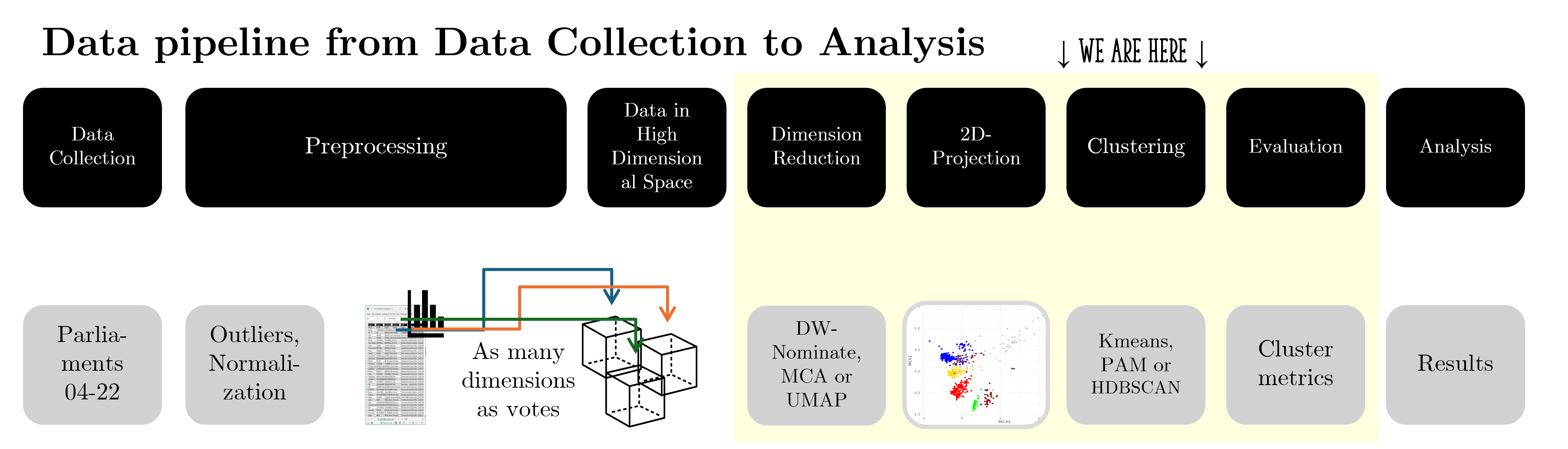
A group of observations that are similar to each other based on a defined set of features. Clustering aims to partition the data into subsets with high internal similarity and high external dissimilarity.
HDBSCAN (Hierarchical Density-Based Spatial Clustering of Applications with Noise):
An advanced clustering algorithm that identifies clusters of varying density in the data. It also designates outliers, often as Cluster 0, which are considered noise.
K-means Clustering:
A partitioning algorithm that divides data into a pre-defined number of clusters by minimizing within-cluster variance.
PAM (Partitioning Around Medoids):
A clustering method that selects medoids as representative points and minimizes the sum of dissimilarities between each data point and its nearest medoid.
UMAP (Uniform Manifold Approximation and Projection):
A dimensionality reduction technique that preserves the local and global structure of the data while reducing it to 2D or 3D for visualization.
MCA (Multiple Correspondence Analysis):
A method for reducing the dimensionality of categorical data by representing it in a lower-dimensional space.
DW-NOMINATE:
A scaling method commonly used in political science to map voting behavior onto ideological dimensions, such as economic and social dimensions.
Silhouette Score:
A measure of how well each data point fits within its cluster. A higher score indicates better-defined clusters.
Davies-Bouldin Index:
A metric for evaluating clustering quality by measuring the ratio of within-cluster spread to between-cluster separation. Lower values indicate better clustering.
Calinski-Harabasz Index:
An index that evaluates clustering performance by comparing the dispersion of points within clusters to the dispersion between clusters. Higher scores are better.
Normalization:
A process to scale the data so that each feature contributes equally to the analysis, typically by adjusting the values to a standard range or scale.
Feature Engineering:
The process of selecting, transforming, and creating features to improve the performance of machine learning models.
Complete Case Analysis:
A method for handling missing data by excluding observations with any missing values.
Radar Chart:
A graphical method of displaying multivariate data in the form of a two-dimensional chart of three or more quantitative variables represented on axes starting from the same point.
Box Plot:
A visualization technique for summarizing the distribution of a dataset and identifying potential outliers.
Interactive Parliament Plot:
A custom visualization that maps Members of the European Parliament (MEPs) and their respective parties onto a semicircular plot with clickable interactivity.
Correlation Coefficient:
A measure of the strength and direction of the linear relationship between two variables, ranging from -1 (perfect negative correlation) to +1 (perfect positive correlation).
R-squared (Coefficient of Determination):
Represents the proportion of variance in the dependent variable that is predictable from the independent variables.
Adjusted R-squared:
A modified version of R-squared that adjusts for the number of predictors in the model, penalizing the inclusion of irrelevant variables.
EPG (European Political Group):
The official grouping of Members of the European Parliament based on shared political ideologies.
MEP (Member of the European Parliament):
An elected representative in the European Parliament.
Voting Alignment:
A measure of how frequently MEPs or parties vote in line with one another.
Shiny:
An R framework for building interactive web applications and dashboards for data analysis and visualization.
reactable:
A package in R for creating interactive and customizable tables with advanced features.
ggplot2:
A widely used R package for creating elegant and versatile visualizations.
Cluster Stability:
The extent to which clusters remain consistent across different sampling or parameter settings, often tested through bootstrapping.
Outliers:
Data points that deviate significantly from the majority of observations, often identified and excluded in clustering.
Bootstrap Analysis:
A resampling method used to estimate the stability of clusters by creating multiple datasets through random sampling with replacement.